Really the fastest Z80 aka CP/M computer emulator
Simeon Cran publishes 1998 the last version of MyZ80, the fastest >Z80< and CP/M computer emulator for DOS, totally written in assembler. But it's still running with Windows XP (Vista users: It's a 16 Bit application, so bad luck for you).
A few years ago a shareware version of MyZ80 in the Simtel archives were located >here<. Unfortunately Simtel deleted all the useful old stuff meanwhile.
It's a shareware version, but the author of MyZ80 can't be contacted anymore (the last known mail address >s373718@student.uq.edu.au< isn't working anymore).
You can find this shareware version still at >microcodeconsulting.com< (for myz80111.zip, scroll down a bit), an interesting place also for >QP/M<.
The latest version was MyZ80 Version 1.24 and adds some additional API functions and a few other speed and functional enhancements (funny, a "Robotron" terminal emulation too), for a full list see >here<. Also, MYZ80 >can use the serial interface< of the PC and offer it also for CP/M. Because this software is abandoned from the author since many years, I will offer it here for non commercial and academic purposes only also, try >this here<. I will remove this immediately if the author, Simeon Cran, let me know that he didn't like that (even after almost 25 years of silence).
MyZ80 is 100% compatible with CP/M 2.2 and CP/M 3.0, but >QP/M< from Microcode Consulting seems to be a bit incompatible - surprisingly because they offer a MyZ80 package.
Look at these screenshots, made with the latest MyZ80 version (1.24) and CP/M 2.2, 3.0 and QP/M:
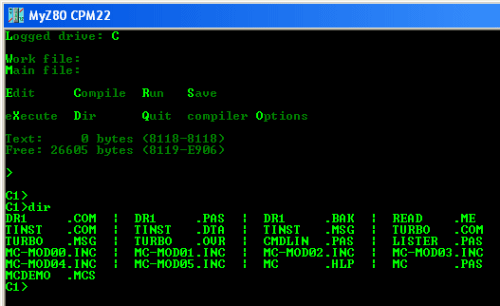
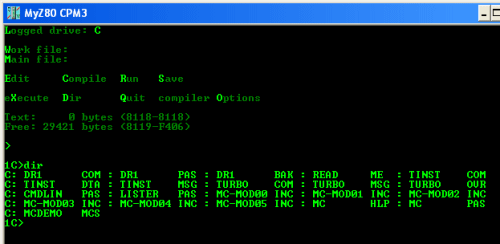
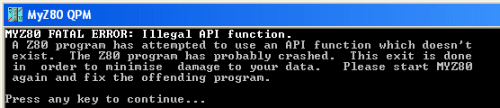
It's does only occur if USER 1 (or more) is used. Turbo Pascal 3 seems to write something back or tries to set the drive when terminated with 'Q' - an API function which seems to be incompatible (with other USER areas than 0) in QP/M.
But QP/M is still interesting in terms of speed and functionality.
Hint:
If you're using Windows 7 (or Vista) x64, you can't execute 16bit programs. So you have to use a virtual machine or an emulator.
VMware Player is an excellent choice (and free), but you have to install an OS first. So >DOSBox 0.7x< is may be a better choice because it's also able to execute it, and it offers already a build-in DOS 5.0. Although it's a bit slower than VMware Player, you can speed it up easily:
To get maximum speed in DOSBox, set a few options in the DOSBox config file.
For Windows 7, this is located this is located in %LOCALAPPDATA%: core=dynamic
cycles=max
Other emulators:
Z80MU v5.2 from Joan Riff (uses the guest OS file system)
CPEM (Knight Software, can emulate Z80 also, can support V20/V30, uses the guest OS file system)
Newer ones:
YAZE AG Yet another Z80 emulator - the latest version is maintained from Andreas Gerlich, CP/M 3 pack for YAZE >here<
Z80EM86 is a CPU emulator entirely coded in x86 assembly language, a >CP/M 3 system< can be found at >Gaby's Website< also, as well as the >sources<. Thx to Stewart Kay for the program and the updated info.
Z80PACK from Udo Munk (this site also offers a lot of other interesting things like a PL/M compiler and a reconstructed CP/M 1.4). A mirror of this site can be found at z80cpu.eu >here<.
Z80EMU from shaels.net , running with Windows natively
Altair 8800 simulator (with SIMH) from Peter Schorn running CP/M 1.4-3.0, QP/M, Personal CP/M, DOS Plus a.s.o. like IMDOS (!).
Unfortunately, the last one in this list, the Altair 8800 simulator, had a problem with the handshake/negotiation when telnet is used - and you have to use telnet, because there is no terminal emulation included.
sim> set telnet console=23 wasn't working well (chars are lost when ESC-sequences are bind to cursor keys while editing files with Turbo PASCAL).
But it's also possible to send all console output to telnet with:
sim> attach sio 23
(Meanwhile Peter Schorn has altered the program to correct this, so it can be working now also with "set telnet console=23".)
With Hyperterminal from Windows it's not possible to get a usable connection (over TCP/IP and Winsock), with the console application telnet.exe there is no problem (but also no terminal emulation). A telnet connection with Kermit-95 will work seamless with a proper configuration:
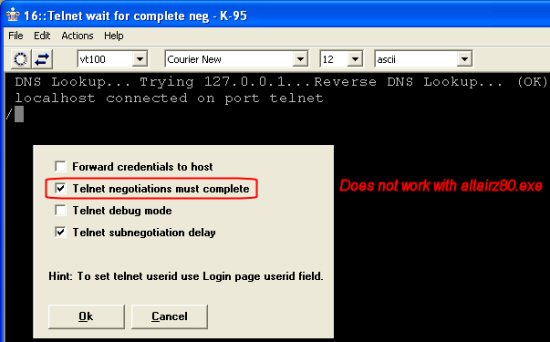
Just uncheck "Telnet negotiations must complete" and it will work.
Peter Schorn's Altair SIMH works very well and emulates a lot of hardware (e.g. beside the >Altair 8800< also an IMSAI 8800). It's interesting looking at the old MITS Disk Extended BASIC 4, Altair DOS 1.0 and IMDOS 2.05 as well. Do not be confused about the cryptic console commands, Peter Schorn provided every package with a script file, so just start the simulator and type in 'do scriptname' (e.g. 'do imdos' to boot IMDOS).
|